Contact us

Thank you! Your submission has been received!
Oops! Something went wrong while submitting the form.

The Most Effective Way to Build Safely

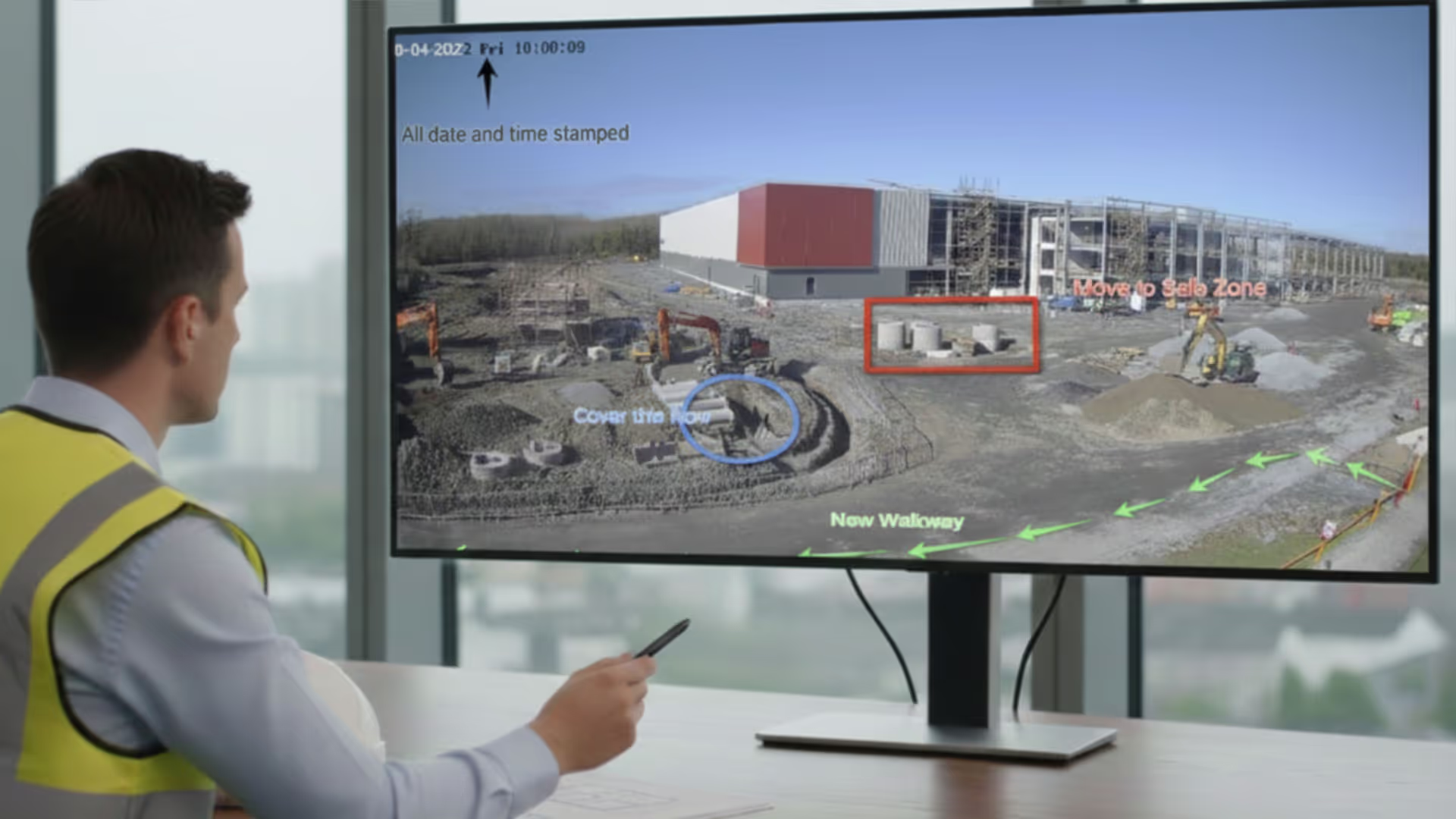
Monitor your job sites, detect safety risks, and prevent incidents with reality-based intelligence.

Better Safety Starts With Real Data

Why safety breaks down on real jobsites

Incidents are investigated based on stale memories rather than real-time data

Critical near-misses go unreported and unaddressed

Lack of objective proof makes fraud or exaggeration hard to debunk

Safety leads spend hours hunting for footage instead of managing risks

Core Safety Use Cases

What our Customers are Saying

The installed Evercam provided reliable high quality live images of our construction site. The live images were useful for keeping the wider project team (non-site based) informed of construction progress which in turn helped them to prioritize their work on the project. The historical recordings were useful when reviewing Contractor variation claims and for monitoring site safety practice. Overall, Evercam provided good value to the project.

Damon Howes
Project Manager, Water Corporation WA

The value Evercam brings to me is the ability to spot check items that are brought to my attention. I frequently use Recordings playback for moments when others state "this happened" and verifying the severity of safety that is either in question or being analyzed. I can also use Recordings as an educational tool to show teaching moments as safety training is an important part of my role.

Joseph Walsh
Manager, Skanska USA

BIM Compare has been instrumental in our safety planning efforts. By comparing the design model with actual site conditions, we can identify potential hazards and implement preventative measures.

Ryan Cardoza
Safety Manger, Skanska

We have been very happy with the service from Evercam and thanks again Emilio for your assistance over the recent past. The footage from the Evercam cameras was particularly, useful as it provided high-quality video images for use in a number of health & safety and security reviews during the construction phase of our new automated warehouse.

Dave O Flynn
Project Manager, Dixon International

Customer-Reported Results

Faster Investigations

Reduced Legal Exposure

Lower Claim Costs

Stronger Compliance Evidence

See your potential ROI →

Related Blog Articles

View Blog
Blog
December 23, 2025

Construction Site Safety: How Fixed-Position Cameras Improve Jobsite Operations

Construction safety is inseparable from operations. It is the daily effort of protecting workers from incidents and protecting the public through perimeter control, clear visibility and fast response when something goes wrong.

Fixed-position cameras help because they reduce uncertainty. They give teams a consistent view of what is happening now, what happened earlier and what changed over time, without adding friction to the job.

Evercam fixed-position cameras are built for long-term site monitoring in 4K+ resolution, with a 110° horizontal field of view and long-range coverage up to 100 meters, including harsh conditions.

Why fixed-position cameras matter for safety (not just security)

When safety breaks down, it is often because teams cannot:

  • verify conditions in high-risk zones without sending people in
  • see a developing issue early enough to intervene
  • reconstruct events when accounts conflict
  • document what happened in a consistent way for internal review and learning

Fixed-position construction cameras support remote site monitoring, jobsite visibility, incident documentation, near-miss prevention and safety compliance by providing a reliable visual record that teams can reference throughout the project.

And when you need the bigger picture, Evercam’s Timeline provides a searchable timeline of your entire project, with no gaps.

Construction workers guiding a crane lift in wet ground conditions
Crane lift operation observed from a fixed camera perspective.

8 real project examples of safer operations with Evercam

These examples reflect common challenges in large-scale construction projects, especially in data centers, renewables and mission-critical builds.

1) Incident investigations without assumptions

Real project example: A Director of Health & Safety needed to review incidents where different people had different accounts of what happened. Footage clarified the sequence of events so the team could focus daily safety huddles on specific contributing factors and safer practices.

Operations takeaway: Clarity improves the quality of corrective action and learning.

2) Compliance verification near sensitive boundaries (aviation risk)

Real project example: On a project near an airport, crane height limits required ongoing attention. The team used live view to monitor crane activity and recordings to verify movements when questions came up later, creating a clear internal audit trail.

Operations takeaway: Compliance gets easier when verification is routine, not reactive.

3) Restricted-zone oversight without putting people in harm’s way

Real project example: A project had a hazardous bowl area with tensioned wires and restricted access. Cameras gave the team “eyes inside” the space so they could manage the zone remotely without unnecessary entry.

Operations takeaway: High-risk zones should be observable without requiring exposure.

4) “Open the site without being on the site” (daily remote monitoring)

Real project example: A Project Manager needed simple, daily visibility without complex workflows. They relied on live view for constant monitoring as a practical substitute for physical presence.

Operations takeaway: Adoption sticks when the workflow is effortless.

5) A safety tool that starts as “documentation” and becomes operational

Real project example: A team initially treated cameras like a marketing or documentation tool. As site constraints tightened, the platform shifted into a core operational safety and visibility system, especially for managing restricted areas.

Operations takeaway: The best safety tech earns its role by solving today’s problem, not by promising tomorrow’s.

6) Stopping a near-miss while it is still a near-miss

Real project example: A supervisor spotted a subcontractor cutting material without proper hand protection in live view. The risk was addressed immediately and the crew adjusted behavior once the footage made the gap clear.

Operations takeaway: Real-time visibility shortens the time between risk and correction.

7) End-of-day checks that prevent after-hours safety issues

Real project example: A site team built a habit: before leaving, someone checked the live view to confirm no workers were still inside the work zone.

Operations takeaway: Small routines can eliminate surprisingly serious failure modes.

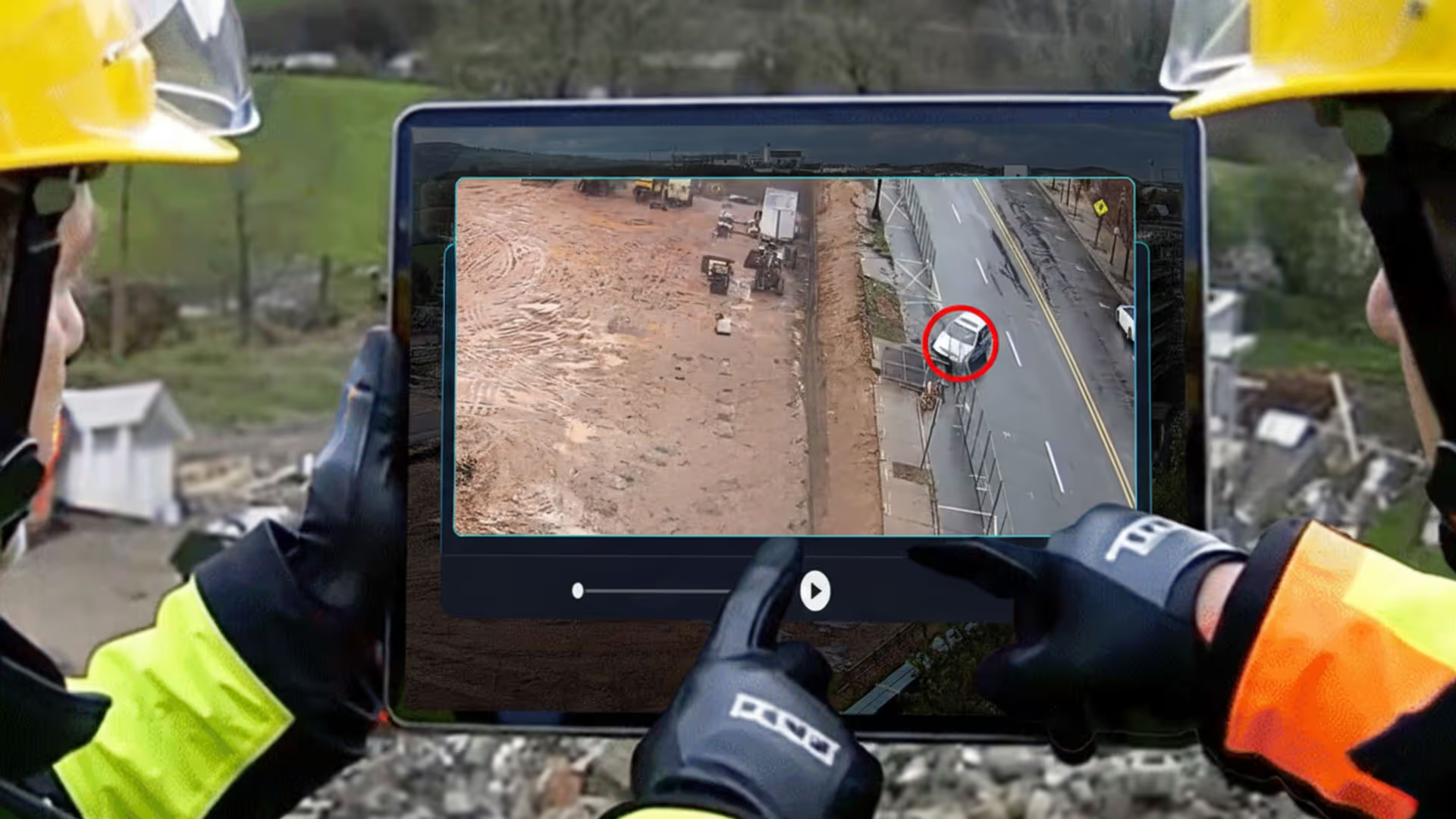
Aerial camera view showing a vehicle stopped near a fenced construction site.
Camera footage capturing a vehicle positioned outside designated site boundaries.

8) Vehicle and equipment incidents with clear context

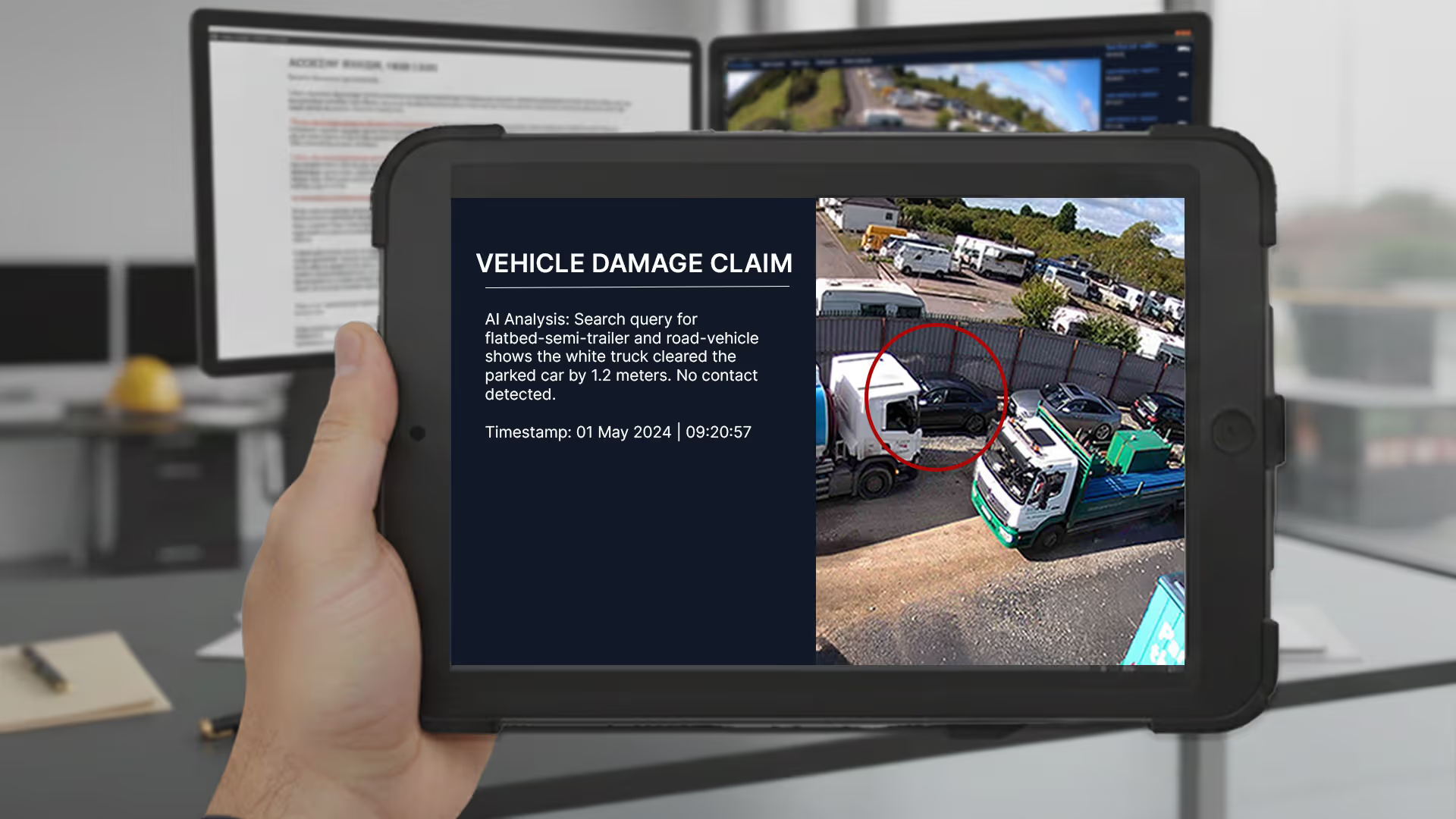
Real project example: A vehicle incident created conflicting witness statements. Footage from Evercam’s Gate Report helped the team confirm what happened so they could focus on practical follow-up and awareness.

Operations takeaway: Fewer debates means faster improvement.

How to improve jobsite safety with Evercam: a practical ops playbook

1) Map your risk zones first

Start with places where visibility changes decisions:

  • public interface + perimeter
  • delivery routes + traffic pinch points
  • lifting zones + equipment travel paths
  • restricted-access areas
  • after-hours exposure points

2) Place cameras for decisions, not aesthetics

Optimize for:

  • stable, wide coverage of entrances and boundaries
  • clear sightlines into high-risk zones
  • reference points that help verify conditions consistently

Evercam’s fixed-position cameras are designed for long-term capture from start to finish, including progress documentation and investigations. Learn more in our Installation Guide.

Evercam fixed-position construction camera mounted in a protective housing.
Fixed-position construction camera hardware installed for continuous monitoring.

3) Set permissions and sharing rules early

Safety improves when the right people can see what they need without over-sharing:

  • define who has day-to-day access
  • establish how clips are shared internally
  • keep review consistent so learning compounds

4) Use Timeline to connect safety moments across the whole job

Incidents and near-misses rarely live in isolation. Timeline helps teams review the project as a continuous record: a searchable timeline of your entire project, with no gaps.

5) Turn incidents into training that sticks

When you can create short internal “lesson” clips from real conditions, training becomes grounded in your site's reality, not generic examples. (From your later insight list #25)

Real ROI

Construction teams using Evercam report measurable time and cost savings across every project phase:

Site Visits Avoided Remote visibility eliminates unnecessary trips. Teams report 20–80% fewer site visits, saving 25+ hours per month and $2k+ per avoided trip. Suncode saved 80% in site visits. Shell Vito avoided 30+ trips during commissioning.

Schedule Recovery Video evidence accelerates critical path decisions. Projects recover 7–15 days on average when disputes are resolved with timestamped proof instead of conflicting accounts. ST Telemedia Philippines cut crane assembly time by 57%—from 7 days to 3 days.

Safety & Compliance Documentation prevents costly claims and speeds incident investigations. Teams save 25+ hours per incident review and avoid payouts ranging from €30k–€200k per project. Barnhill avoided a €31k workers comp claim. OHLA saved €200k in claims defense costs.

Construction workers wearing safety helmets reviewing live site footage on a tablet.
Workers reviewing site activity using a tablet interface.

Why this matters for US builders in data centers, renewables and mission critical construction

These sectors demand strict safety controls, rapid coordination and clear visibility across distributed teams.

These projects move fast, carry heavy coordination overhead, and often operate under stricter controls. Fixed-position cameras and reality capture help safety leaders and PMs keep work legible across distance and time, especially when teams are distributed.

For a visibility-focused example in a complex US industrial context, Evercam’s Shell case study describes improved visibility across multiple locations and a reduction in site visits through visual documentation.

Next steps

If you are responsible for safety outcomes and operational flow, fixed-position cameras can give you a simpler way to verify conditions, document incidents and reduce avoidable risk.

View Blog
Blog
August 7, 2025

5 Ways of Full Video Recordings Benefit Risk and Insurance Management on Construction Sites

Construction sites can be hazardous, unpredictable environments that can lead to accidents, injuries, or fatalities. In fact, according to OSHA, the "Fatal Four" causes of fatalities in the workplace are falls, electrocutions, struck-by-object incidents, and caught-in/between incidents.

These accounted for 59.9% of construction worker deaths in 2017. The financial consequences of safety incidents in construction can be significant, with the average cost of a "fall from a height" incident being $112,000.

America’s safety advocate the National safety council gives an extensive breakdown of the financial implications of work injury as follows:

  • The total cost of work injuries in 2021 was $167.0 billion, which includes wage and productivity losses, medical expenses, administrative expenses, employers’ uninsured costs, and property damage costs.
  • The cost per worker in 2021 was $1,080, which represents the value of goods or services each worker must produce to offset the cost of work injuries.
  • The cost per medically consulted injury in 2021 was $42,000, while the cost per death was $1,340,000.
  • The total days lost due to work injuries in 2021 were 103,000,000, which includes days lost from injuries that occurred in 2021 and previous years, as well as future years from 2021 injuries.

An effective risk management strategy and safety program is crucial for construction companies to mitigate these risks and financial losses. Full video recordings are one such strategy that can provide a comprehensive record of all activities taking place on construction sites, helping to identify potential risks and hazards.

By monitoring compliance with health and safety regulations, capturing every second of construction site activity in 4k video improves overall transparency and accountability on-site operations.

Three construction site video examples showing equipment failure, safety dispute, and vehicle counting dispute used for return on investment analysis
Return on Investment: examples of construction disputes resolved using video evidence

Evercam offers full video recordings as one of its features to help construction companies manage risks and reduce incidents, and costs related to insurance. Here are some of the benefits of using Evercam's full video recordings:

1. Remote Safety Monitoring & Inspections

The features provided by Evercam, such as real-time visibility across all job sites and the ability to perform remote safety inspections in real time, can greatly aid in risk management. By having access to live feed images capturing activity on all projects in one centralized location, safety personnel can quickly identify potential safety hazards and take necessary precautions to mitigate risks.

The edit tool's ability to mark up safety violations and communicate with on-site staff via Procore integration can help to prevent safety incidents before they occur. This feature allows for the quick and easy creation of annotations or tags on the model to highlight important information such as restricted or dangerous areas, enabling on-site teams to follow safety protocols 24/7.

These features enable safety personnel to perform remote safety inspections in real-time on all their job sites via live feed images capturing activity on all projects in one centralized location. This feature can help reduce travel time, enable better preparation for on-site loss control inspections, provide feedback and document the actions taken, and ensure on-site teams are following safety protocols 24/7.

2. Incident Review & Documentation

With Evercam's full video recordings, incidents are immediately visible, and users can request video archives to review incidents in detail. By leveraging this feature, companies can avoid costly job site shutdowns that can result from incidents, such as accidents or safety violations. The ability to quickly determine the cause of an incident and document it using 4k video documentation can help ensure that remediation is implemented promptly, reducing the likelihood of future incidents.

Moreover, having access to full-frame rate recordings (8 frames/sec) of an incident can provide a wealth of information to analyze and determine the root cause of the issue. This information can then be used to develop targeted risk mitigation strategies that address the specific issues identified in the incident review.

3. Claims Documentation & Submittal

Evercam's cloud recording and full frame rate 4k video feature provide the ability to submit insurance claims with high-quality video evidence. This feature also includes weather reporting, which can be used to prove weather delays.

The benefits of this feature include financial benefits from the insurance company for "50% deductible claims accompanying video clips," expediting the claims process, understanding the cause of the incident, and proving that the incident occurred. The visuals and data can also be used to validate delays caused by unforeseen conditions like weather, earthwork, etc.

4. Enable Continuous Improvement & Safety Training

Safety training is a critical aspect of managing construction risks, but it can be challenging to create engaging and effective safety training programs that resonate with employees and effectively communicate safety procedures. Evercam's video editing team can help create internal training videos based on real footage captured on job sites, showcasing examples of safety risks and hazards and demonstrating best practices to mitigate them.

These videos can provide a comprehensive and detailed overview of the potential hazards and risks associated with specific tasks or work environments. They can also offer practical instructions and guidelines on how to identify and mitigate these risks.

Having a dedicated customer success manager (CSM) is an additional advantage in risk analysis and mitigation, and this is a service that Evercam offers. Their unlimited user training and set-up to complement existing health and safety workflows can ensure that employees are adequately trained and equipped to identify and report potential hazards. They also provide ongoing support and guidance to help teams identify and address any safety concerns that arise.

The edit tool can further aid in risk analysis and mitigation efforts by allowing teams to mark up images and proactively communicate safety protocols, instructions, and violations with on-site staff. This tool can help identify potential hazards and violations before they become significant problems and ensure that corrective actions are taken promptly.

The advantage of this feature is that it can help enable the safety team to use Evercam to drive behavioural change, ultimately driving company-wide behavioural change related to safety measures via a process of visual information for continuous improvement.

5. Fraud Prevention

The X-ray feature allows you to see behind that wall; below that floor and provide evidence of the previous condition of the site. This provides proof of events and prevents fraud.

Insurance fraud is a prevalent issue in the construction industry, and false claims can lead to financial losses and higher premiums for construction companies. However, full video recordings can help prevent fraudulent activities by providing concrete evidence of events on the construction site. For instance, if an employee reports a slip and fall accident that never happened, the video footage can provide irrefutable evidence that the incident was staged.

This transparency makes it challenging for individuals to falsify information or stage accidents, ultimately safeguarding the interests of insurers and construction companies. By leveraging full video recordings to deter fraudulent activities, construction companies can avoid financial losses and ensure their insurance policies remain cost-effective.

Full video recordings enable investigation of the incident & determine the cause(s).

In conclusion, full video recordings have become an indispensable tool for managing risks and enhancing insurance efficiency on construction sites. By providing real-time insights into construction activities, identifying potential hazards, and streamlining the insurance claims process, full video recordings are transforming the construction industry. As construction projects continue to grow in size and complexity, leveraging full video recordings will become increasingly crucial in managing risks and ensuring the success of projects.

If you are looking for a reliable full video recording solution for your construction site, Evercam offers a range of AI-integrated cameras and software for reality capture and remote monitoring. Contact us today to learn more about how we can help enhance safety, improve project efficiency, and streamline insurance claims processing on your construction site.

View Blog
Blog
February 15, 2025

Why Communication is the Foundation of Construction Safety

Seeing What Others Missed: Communication in a High-Risk Environment

Roger Boisjoly was a booster rocket engineer at NASA in Utah in 1986. Six months before the launch of The Challenger, Boisjoly and fellow engineers noticed a problem: the elastic seals at the joints of the rockets tended to stiffen and unseal in cold weather.

Boisjoly and his crew reported the problem to the NASA officials in charge of the launch, but project leaders decided to go ahead. Their decision to refute what they interpreted as one man’s opinion resulted in one of the most tragic disasters in aerospace history. As Boisjoly and his team feared, the rocket exploded shortly after launch.

Overhead view of construction workers preparing and pouring concrete on a job site
Undertaking a Concrete Pour in the United Arab Emirates.

Construction Communication is a Result of Physical and Psychological Safety

Boisjoly’s insight—and the failure of leadership to act on it—became a pivotal lesson in the importance of visibility, communication, and documentation in high-risk environments.

Like aerospace, the construction industry is full of dangers that can be mitigated through clear communication. But for workers to report potential physical hazards, a culture that encourages transparent communication must exist.

The first type of safety communication includes safety training, clear signage, high-visibility gear, wearable alert devices, and regular safety meetings to ensure everyone on site understands the risks.

The second aspect of job site communication concerns psychological safety—a company culture where workers feel safe speaking up about hazards or mistakes. Psychological safety is built through transparent leadership and a shared belief that evidence, not authority, determines the best course of action.

Construction may involve risks similar to aerospace, but unlike the 1980s, today’s technology allows us to see more, record more, and act faster than ever before. The question is: are we using technology to communicate effectively?

Prepping a Rebar Grid

The State of Construction Safety: Four Insights

The numbers show that while construction safety has improved over the years, there is still significant room for progress:

  1. The construction industry accounts for 20% of all workplace fatalities
  2. 60% of serious injuries occur due to poor communication and lack of real-time visibility
  3. Delays and miscommunication cost the global construction industry $1.8 trillion annually, much of it tied to poor documentation and coordination
  4. An estimated 30% of construction firms have software that doesn’t integrate their visual data into a unified platform that would allow them to see and manage projects remotely

The statistics are clear: too much is left unseen. And what you can’t see, you cannot communicate. When communication fails, workers' lives, project schedules, and successful outcomes are all put at risk.

One of Evercam's Fixed Position Cameras Recording Site Activity

Visibility, Recording, and Collaboration in Construction

How do we improve as an industry? The answer lies in technology and a shift in values.

Values: A Cultural Shift Toward Transparency
At Evercam, we believe the construction industry is moving toward collaboration and accountability. We also believe that, for safety and economic reasons, all construction will be recorded. The belief that “all construction will be recorded” may sound extreme, but for companies that prioritize their workers’ well-being, it’s a logical step forward.

Today, our global society has come to value human life more than in centuries past. Workers’ rights and safety are a priority. Construction firms, on the whole, realize that it is morally, ethically, and financially unwise to allow people to work in an unsafe environment. As industry awareness around the relationship between communication and safety grows, the safest construction companies are eager to adapt new technologies that help teams communicate quickly, accurately, and in real time. Companies that don’t adopt new tools may find themselves falling behind.

Technology: The Tools for a Safer Future

Technology is transforming how construction teams see, record, and collaborate, providing visibility that ensures teams can leave off reacting to problems in favor of preventing them altogether. Evercam is at the forefront of this transformation, offering a single source of truth—inarguable evidence— that is accessible to all.

Here’s how construction companies use Evercam to save time, money, and lives:

  • Incident Documentation: When something goes wrong, having video evidence ensures clarity, accountability, and fair resolution.
  • Real-Time Oversight: Live monitoring eliminates guesswork, helping teams catch hazards before they escalate.
  • Collaboration Beyond the Jobsite: Remote access means stakeholders, safety officers, and project managers can make decisions together, even from different locations.
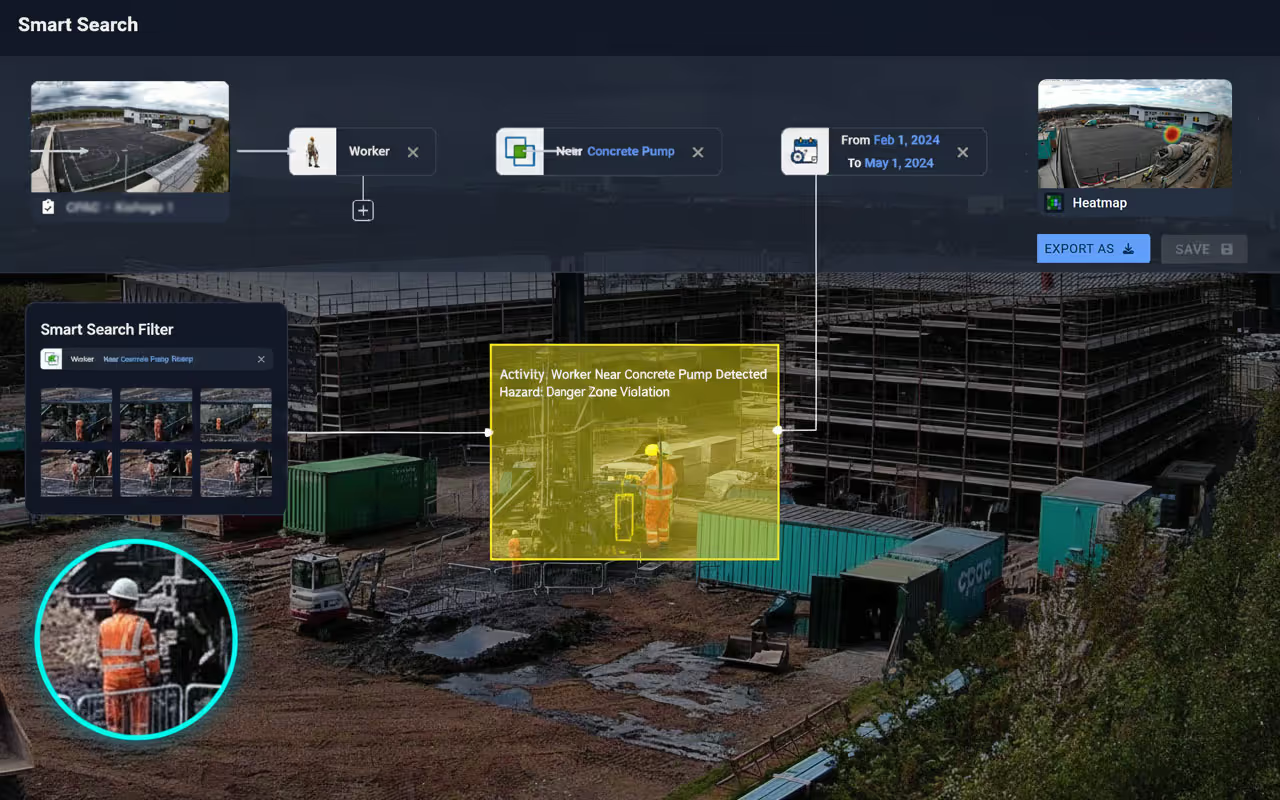
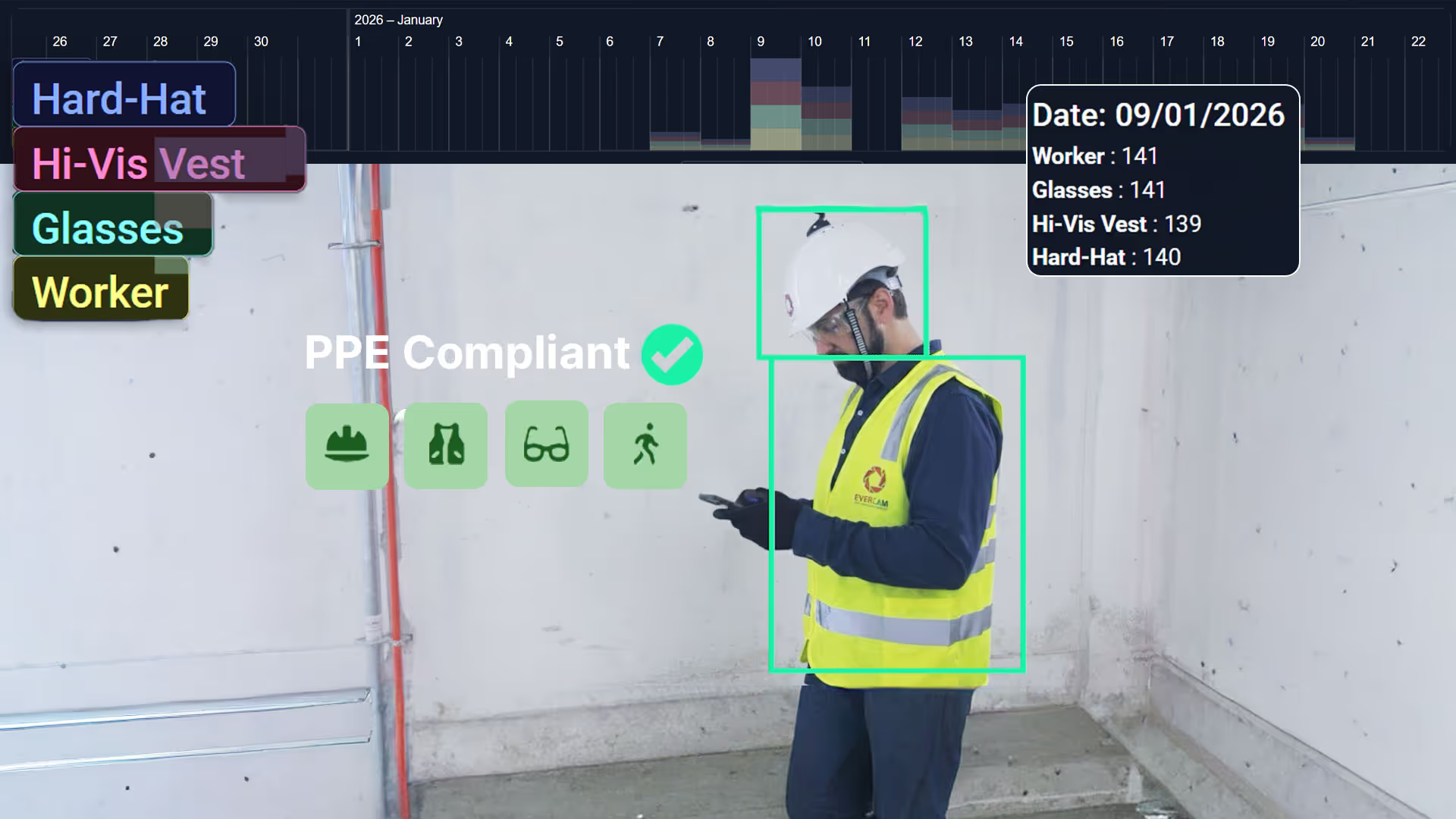
  • AI-Powered Insights: Smart analytics transform raw footage into actionable safety data, preventing issues before they arise.
Sharing Visual Technology to Communicate Effectively

Using the Right Technology Increases Communication

Construction safety isn’t just about seeing hazards—it’s about verifying that what is seen gets communicated, understood, and acted upon. This action takes place in an environment where communication is welcome and transparency is encouraged.  

A perfect example comes from the PM Group, where site managers used real-time construction updates via Evercam to improve communication and coordination during fire alarm testing. David Harrison, a PM Group representative, shared how Evercam’s construction monitoring platform allowed him to overlay the most current site layout onto planned testing zones. This meant workers received precise, up-to-date information, preventing confusion and ensuring everyone on site was aware of the impact before testing began. Because of this accurate, real-time data, the notification process was streamlined, and disruptions were minimized.

Technology alone won’t fix communication gaps, but it is a crucial tool for companies that already foster an atmosphere of transparency among their people. Leaning into an overall culture of safety while utilizing construction technology to communicate will create a future that is more efficient—and safer for everyone.

Get in touch and let us know how visibility can help your team!

View Blog
Blog
August 2, 2017

Construction Magazine Feature Evercam Health & Safety Tool

The May June 2017 issue of CIF Construction Magazine features Evercam Case Study and looks into the multiple ways that cameras can improve site safety as health & safety tool.

Onsite CCTV as a Health & Safety Tool

Contractors are increasingly using video technology for a range of reasons. Traditionally, video cameras served security functions, but more recently, health and safety compliance and marketing opportunities have driven wider adoption across construction sites.

Time-lapse footage of major projects has become common across the industry. A more recent development is the use of live video feeds to support site safety and operational oversight. Construction camera footage provides teams with visual records that can be reviewed to understand incidents, near-misses, and on-site behavior.

From a safety perspective, having access to recorded footage allows project teams to review events after an incident occurs and demonstrate what happened. This supports corrective action and helps prevent similar incidents in the future.

Case Study: Evercam Site Safety Camera in Operation

The Construction Magazine feature includes a case study of Evercam’s system in operation on a Stewart Construction site on Harcourt Road, Dublin. The system was installed to provide a detailed view of the build and to demonstrate the end result of the project.

According to Stewart Construction, the ability to review footage helps reinforce safe behavior on site. Workers are aware that activity is monitored, which encourages adherence to safety protocols. In the event of an incident, the footage allows teams to review events accurately and address issues proactively.

Construction Magazine cover image featuring Evercam’s onsite CCTV health and safety use case.

FAQs

Practical information about how Evercam imrpoves site safety, what to use it for, and how teams benefit.

How does Evercam improve construction safety?

Evercam improves construction safety by providing continuous, time-stamped visual records of site activity, allowing teams to identify risks early, investigate incidents faster, and prove compliance with safety procedures.

Can Evercam help prevent safety incidents?

Yes. Evercam helps teams proactively identify unsafe conditions, poor sequencing, and access conflicts before incidents occur by giving real-time and historical visibility into jobsite activity. Learn more about our privacy and data protection approach.

How is Evercam used after a safety incident?

After an incident, teams use Evercam to reconstruct the exact sequence of events using time-stamped footage, reducing reliance on statements and speeding up investigations and reporting.

Is Evercam used for insurance and claims?

Yes. Evercam is commonly used to support insurance claims and defend against false or disputed safety allegations by providing objective visual evidence of site conditions and activities. Service availability is defined in our Service Level Agreement.

Can safety teams monitor sites remotely with Evercam?

Yes. Safety teams use Evercam to perform remote inspections across single or multiple sites, reducing travel while maintaining consistent oversight.

How is Evercam different from standard CCTV for safety?

Unlike standard CCTV, Evercam is built for construction workflows, offering searchable, long-term footage, investigation tools, and integration with project and safety processes.

Build Safer Sites With Visual Intelligence

Request a demo and see how visual intelligence helps identify hazards, validate procedures, and support compliance.