
At Evercam, we believe that all construction will be collaborative. But what does that mean for the software systems that we use?
Like anything, it starts with the people building that software. We are fortunate to have great builders and leaders who employ the spirit of collaboration daily, like our own Shannon Keeler Brown. A recent conversation with leading healthcare tech voice Brendan Keeler, led her down the rabbit trail to answer the question: What happens when construction software stops relying on humans to tell it what's happening?
This post is from Shannon Keeler Brown, Chief of Staff at Evercam. Shannon brings a unique perspective on construction technology, bridging the gap between operational workflows and emerging software infrastructure. In this piece, she explores how visual data is shifting from documentation tool to foundational primitive in the construction tech stack.
From Human Error to Ground Truth: Rebuilding Construction's Infrastructure
The last generation of construction tech digitized plans. The generation we're living in now is digitizing reality.
The race is on to bring plans and reality together into a single view. Today, answering "Is the slab pour on schedule?" means digging through P6, Procore, and a dozen folders. Soon, you'll just ask the system one thing: 'Show me.' And you'll get one, unified answer.
When those two finally converge, that’s when construction productivity will finally take off. In the scramble to get there, some companies will merge and scale, while others will be absorbed by Procore or Autodesk.
But to understand the future, we have to look at the past. The spark for this thinking came from outside construction. My brother, Brendan Keeler, writes about healthcare tech, and his piece, There Will Be Bundling, explains a universal pattern. He describes how every system of record eventually creates gravity—for workflows, integrations, and wallet share. Once that gravity forms, the system doesn’t die. It absorbs.
That’s exactly what happened in construction with Primavera P6. For decades, it has been the center of gravity that contracts, payments, and coordination orbit around.
So that leads me to the question that drives this entire piece: What happens when the source of truth stops being what people type... and starts being what the system sees?
Construction Software Ecosystem Analysis
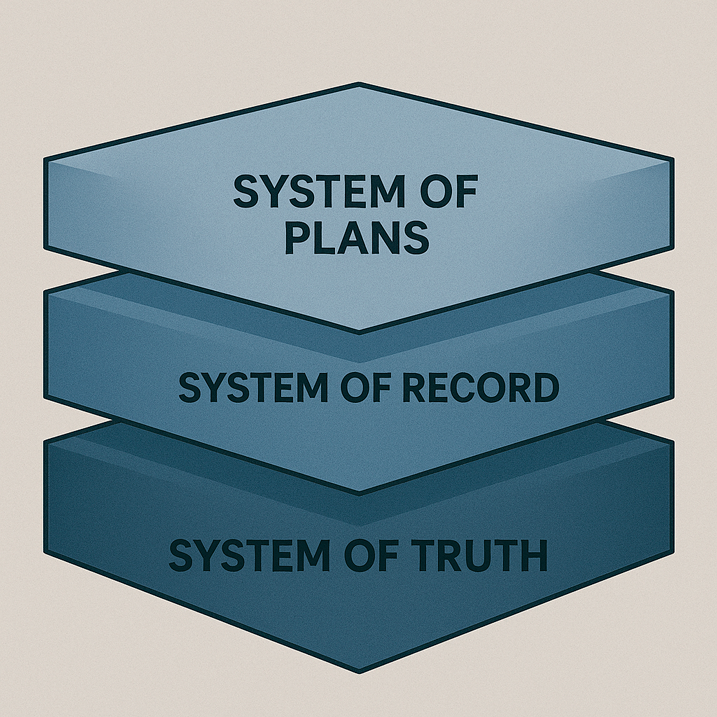
Three Core Categories
System of Plans
This is where the intent lives. The "what we mean to do" layer. It includes:
- Schedule (Primavera P6, excel, etc) - the theoretical schedule, what's supposed to happen, and when
- BIM tools (Revit, Navisworks, Synchro) – the theoretical design, what it's supposed to look like
These tools are deeply embedded into contracts and processes. P6 and scheduling especially are old, complex, and difficult to change, but every large project still runs on them. Schedules live in P6. Designs live in Autodesk, Revit, and Navisworks. Everything else orbits around them.
P6, in particular, is bloated and rigid, a legacy system with an enormous install base that persists due to contract dependencies and industry inertia. It's not built for real-time collaboration or in-field updates.
BIM tools have modernized more, and when they're linked to the schedule, you get 4D, a powerful idea that lets you visualize what will happen and when. But it's hard to pull off in practice. There's no real standard for schedules. Everyone builds them differently. P6 is a closed system. Integration is clunky. And VDC teams are already stretched thin. Very few GCs have the resources to manually sequence the schedule with the BIM models on a regular basis. Not even in the age of ever-expanding AI has a technology out there figured out how to make this process easier. It's time-consuming, expensive, and not built into most project budgets.
So even when BIM and scheduling tools are paired, they still fall short. Because neither knows what's actually happening.
They encode intent, not reality.
System of Record
This is supposed to be the official history. The record of "What happened." Actual site conditions. Transcribed 99% by humans.
Today, it's mostly:
- Project Management Software – Procore, Aconex, Autodesk Construction Cloud (ACC)
- Financial & ERP Systems – CMiC, Viewpoint (Trimble), Sage
- Delivery & Logistics Platforms – Voyage Control, Plot Safety & Compliance Tools – HammerTech, Smartvid
- Schedule Maintenance Overlays – VisiLean, Foresight, ALICE
These systems are where jobsites try to stay organized. RFIs, daily logs, submittals, observations, manpower counts, inspection results, pay apps, the stuff that makes the project "official." The problem is, every part of it is based on people. People writing things down. People remembering what happened. People covering themselves. People forgetting.
Procore doesn't know if the slab was actually poured on Wednesday. It just knows someone wrote it down that way. And maybe they were right. But maybe they were off by a day. Maybe they didn't show up until Thursday. Doesn't matter what actually happened, that's now the record.
Even schedule updates, milestone reports, and progress photos are subject to the same thing: human interpretation. Owner-side PMs walk the site and mark off what they think was completed. The GC gets a drone flyover every few weeks and highlights a few percent increases. Superintendents are entering manpower and delivery data by hand, usually while juggling twenty other things.
The fatal flaw? These systems are only as good as their inputs. And the inputs are human. And humans are flawed.
Humans are tired. They rush. They're biased. They can't see everything. And only about 1% of humans have the photographic memory, or the time, to fill out a daily report that actually meets spec. Every single day for the full life of the job.
They don't want to get in trouble. They're not incentivized to share bad news. They misremember when things happened. They rely on whatever's in their text threads or the last three photos on their iPhone. That becomes the record.
But it's not the truth. It's just what someone said the truth was, well after the fact. So the result is a system of record that is:
Prone to bias. Slow to update. Full of gaps. And constantly disputed.
That's why coordination meetings turn into arguments. That's why owners bring in third-party consultants to verify progress. That's why lawsuits happen.
Because everyone has "a version" of what happened. And none of it is objective.
The irony is that the schedule itself, Primavera P6, is supposed to be a system of plans, but in practice it also becomes the system of record. People "status" the schedule based on what they believe happened. But even that is delayed and depends on someone doing the work.
Tools like VisiLean, Foresight, or Alice try to bridge the gap, but they're still layered on top of flawed data. They're making the best guesses they can, based on whatever's in Procore, whatever's been emailed, whatever was manually uploaded.
And so we're back at the core problem: The record is not the truth. (It's just what someone said the truth was).
System of Truth (The Data/Infrastructure Layer)
This is what actually happened. This is where reality capture comes in. The infrastructure layer. The source of "What actually happened."
The Infrastructure Layer includes:
- Fixed-position cameras (time-lapse, livestream, AI-enabled): Evercam, Earthcam, Truelook, Oxblue
- 360 image capture (structured walks, handheld, robotic)
- Drones (periodic aerial capture, orthomosaics, site conditions)
- Lidar and scanning tools (as-builts, deformation, volume calculations)
Unlike the first two systems, this one isn't based on intent (what should happen) or recollection (what someone said happened). It's based on reality. Unbiased, timestamped, sensor-based documentation. No opinions. No summaries. Just the raw record of what occurred.
The defining difference? No one needs to write anything down. The system is always recording. Always available. Always verifiable.
But here's the thing: most of this footage exists in silos. A drone scan saved on someone's desktop. A 360 video uploaded to a folder no one opens. Camera footage used reactively, if at all. The data is there, but it's not yet infrastructure.
What's emerging is the shift from footage as artifact to footage as evidence - data that can be queried, compared to the plan, and tied to specific milestones, trades, and specs.
A few examples:
"Did the steel delivery happen Tuesday or Thursday?"
"Was the fireproofing actually finished before inspections?"
"Did that incident happen during work hours or after?"
"Can we prove the safety rail was installed before the fall?"
Visual data gives you those answers, without relying on someone to remember or report it. This doesn't mean plans and records go away. But it means the plans and records and everything else has to start aligning with something real. Because when visual truth exists, it becomes the arbiter. Plans adjust to it. Records are validated by it. Meetings move faster. Disputes get resolved. Risk drops. Confidence goes up.
It takes what works perfectly in theory and replaces it with the truth.But it only works if that truth layer is connected. Right now, most systems of truth are disconnected from systems of record. They're not integrated into scheduling tools. They're not feeding data into Procore or P6. They're not structured. Not searchable. Not smart.
That's the next wave: Turning passive footage into active infrastructure. Structured, queryable, integrated. So the system of truth isn't just a backup plan: it's the foundation that everything else builds on.
The Industry Doesn't Trust the Schedule
Let’s be honest — “on schedule” is one of the most creative phrases in construction.
Ask anyone who’s lived through a major project. No matter how detailed the Primavera P6 plan is, or how many milestones are marked complete, everyone on site knows the truth: what’s supposed to happen, in what order, and when — typically isn’t what’s actually happening.
The schedule is a fiction we all agree to pretend is real. Until it isn’t.
And yet, it’s still the backbone of every contract, payment, and claim. The lease gets signed based on it. The owner gets held to it. The GC gets paid off it. Even when everyone quietly knows it’s wrong.
Why? Because there’s no shared source of truth. Everything depends on what someone says happened - the CPM, the site log, the “progress update” email. No one’s cross-checking it against visual proof until it’s too late. That’s why owners don’t really trust the schedule. Neither do GCs. Neither does anyone who’s ever tried to reconcile a milestone payment against what’s actually happening in the field.
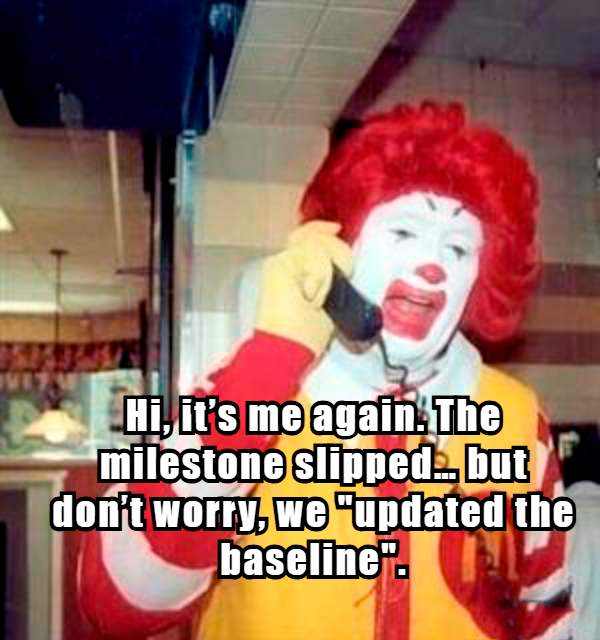
P6 is still the default for large projects — outdated, rigid, and nearly impossible to adapt to real-time decisions. Its waterfall structure guarantees a lag between what’s planned and what’s real. Integrations are painful. Collaboration is clunky. By the time updates hit P6, the project’s already moved on.
It’s unfriendly, hard to build on, and impossible to kill. Because it’s entrenched. Because contracts depend on it. Because everyone else uses it.
But a new system is emerging, not built on human inputs, but on the ground truth.
Humans are the Bottleneck
Today’s construction systems depend on humans. Flawed, overworked humans. Often with selective memory. Telling them what happened.
As Diana Kay of Suffolk Tech observed highlighted in Last Week in Contech: 2025 Construction Tech Opportunity Map, "Today’s systems of record often require manual input, an unrealistic expectation on job sites where workers are focused on completing their tasks rather than logging information."
A delivery manager logs the truck in a spreadsheet when it hits the gate. A PM updates the P6 schedule after the concrete pour — usually a day or two later. The superintendent checks a box in Procore to mark “framing started,” based on whatever the foreman texted him. Someone in the office uploads progress photos on Friday because they finally had time to organize them.
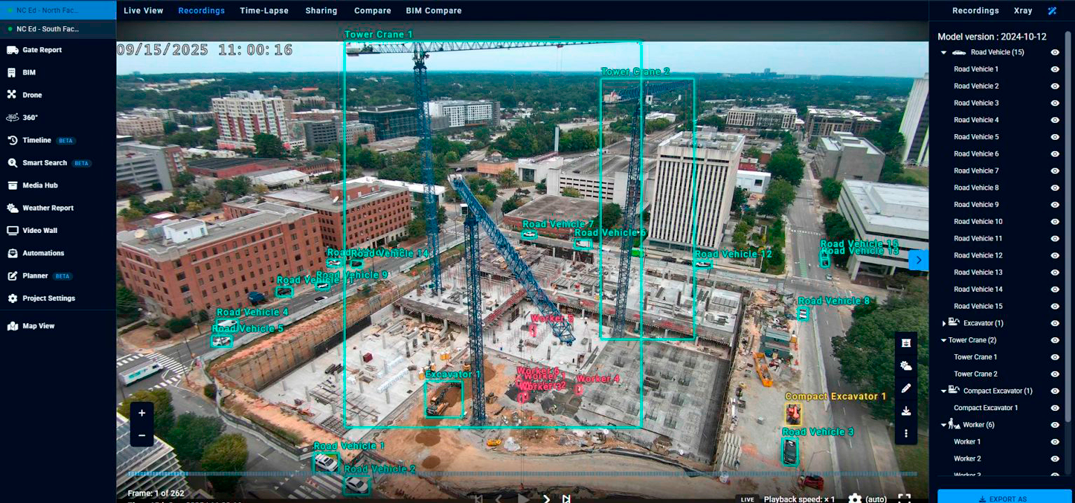
But what if the system just knew? That’s what reality capture + AI (thank you Gemini, ChatGPT, and the open-source ML models built by construction nerds on GitHub) is starting to enable.
Cameras see the rebar go in. Drones measure the stockpiles
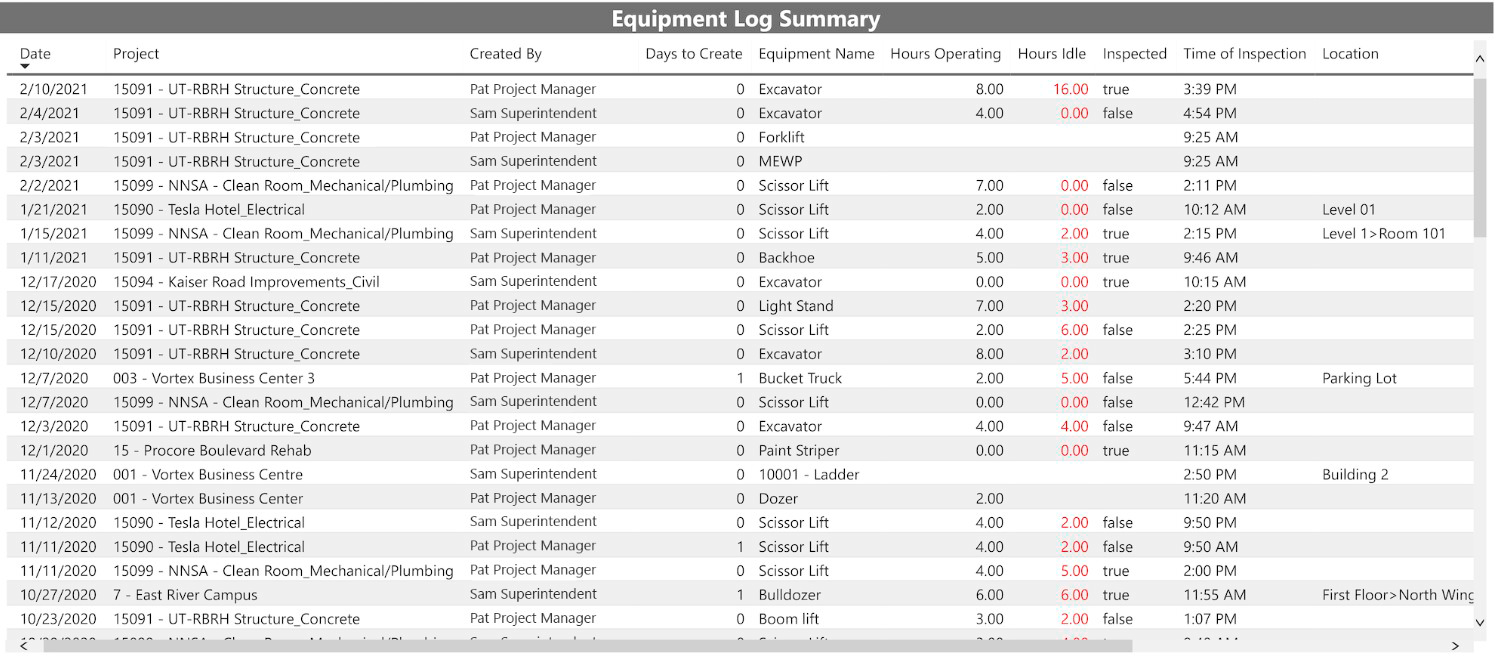
Algorithms trained to recognize cranes, manpower, concrete pumps, and excavators can now timestamp and tag site activity automatically. And ship those insights over to Aconex and Procore.
Raw images become structured data --> Data turns into insights --> And those insights feed the system's of record.
5 Tower Cranes detected 8am Wednesday ----> Send to Procore Equipment Log
But this isn’t just a technology shift — it’s a trust shift.
Because when every stakeholder sees the same thing, in real time, trust stops being a personality trait — it becomes a shared dataset.
That’s the transformation Nancy Novak talks about in Time to Rethink the Owner–Contractor Relationship:
“Let’s move from transaction to transformation — building partnerships that last longer than the projects themselves. Because when owners and contractors stop pulling against each other, we unlock the strength to pull the whole industry forward. When relationships are built on trust and collaboration, the work sings. When they’re transactional, the work stumbles.”
She’s right. The problem isn’t that people don’t want to trust each other — it’s that trust is hard when contracts are written for zero-sum games and the “what actually happened” lives in spreadsheets, half-filled Procore logs, email threads, and flawed memories.
That transformation doesn’t start with softer contracts or more meetings — it starts with shared truth.
You can’t collaborate around different versions of reality. When everyone’s looking at the same dataset, trust isn’t a leap of faith — it’s a byproduct of visibility.
And it’s not just about how owners and contractors treat each other — it’s about how the systems we use shape those relationships. When data is fragmented and subjective, it breeds defensiveness. When truth is shared and visible, collaboration becomes the default.
A shared system of truth makes trust easier. It resets the baseline. It removes the need for selective reporting or spin.
When reality becomes the reference point, everyone, owners, architects, contractors, trades — can stop arguing about who’s right and just see what’s real.
Reality Capture Will Be the Next Primitive
Every system of record creates gravity — for workflows, integrations, and wallet share. Once that gravity forms, the system doesn’t die; it absorbs.
That’s what’s happened with Primavera P6. It’s been the primitive in construction for decades — the root layer everything else depends on. Contracts reference it. Coordination revolves around it. Payments, disputes, and progress all trace back to it.
But P6 represents intent, not reality. It tells us what was supposed to happen, not what did. And because it’s built on human input, it’s inherently lagging behind the truth on site.
The next primitive won’t be built on what people type in, it’ll be built on what the system sees.
The gravitational center is already shifting toward reality capture — fixed cameras, drones, 360 images, lidar scans. The infrastructure that captures and verifies what’s actually happening in real time.
Evercam’s evolution mirrors that shift. We started as a point solution, cameras on site, and more recently, a reality capture and intelligence platform support fixed, drone, & 360, but we’re becoming the infrastructure beneath the record. Not a replacement for P6 or Procore, but the foundation they’ll begin to rely on.
As Brendan puts it, “Infrastructure players win by being indispensable — the invisible backbone everyone builds on.”
That’s exactly what we’re building toward: the invisible backbone of truth that powers every other system in construction.
Do We Want to Be the System of Record?
In the traditional sense, no. We don't want to be the next Procore or P6.
We want to change how the system of record is powered, used, and needed.
Evercam, if built correctly, is not the system of record. It is the infrastructure beneath it. In the same way Stripe powers Shopify. The way Plaid powers Venmo. How school attendance software is powered by the teacher's clipboard.
Right now, that infrastructure is still human. PMs entering daily logs. Superintendents counting trucks. Owner-side PMs snapping milestone photos to send to the bank. All of that is manual infrastructure, and all of it is flawed.
Nobody owns the truth because the record is only as good as the person who wrote it. And when the infrastructure is people, the system is slow, subjective, and easy to dispute.
We believe we can shift that infrastructure to something more reliable. Objective visual data. Imagery, AI, drones, fixed cameras, 360 capture, BIM overlays, P6 schedules, and specs. Fused together to tell the story of what actually happened, without someone needing to type it up.
Think of how we used to store phone numbers. You had to manually write them down in a notebook. Then came the rolodex. Then the contact list in your phone. And now? You don't even store most numbers. You just search them. Ask Siri. Google it. You don't need the pizza guy's number anymore. Or the electrician. Or your tax man. Because you know you can type it into google and find their numbers when you need it.
That shift, from manual entry to ambient access, is the same shift we're creating in construction.
A reality capture provider won't win by trying to get every PM, superintendent, owner, and marketing person to log in daily to manually dig through visual data. We win by making that need obsolete.
The right information, people on site, weather, milestones, deliveries, already captured. If something goes wrong, they just ask:
"Did rain in August really cause a 3-day delay?" "There's a crack in Fab 2. When was the concrete poured? By who? Show me the footage." "Was that safety protocol followed?" "How many people were actually on site last Tuesday at 7 a.m.?"
Right now, all of these rely on humans. Humans who are tired, busy, biased, or just trying to cover themselves. That's why timelines are wrong. That's why meetings start with a debate over what actually happened.
We want to remove that layer of uncertainty.
"Hey Mr. Owner, it rained two days in August. Here's an RFI for 2 days back," says the PM.
"It didn't rain here. And Weather.com shows it only rained 30 minutes," the Owner replies.
"Oh, but the weather station is a mile away," the PM counters. "Well, if it rained, show me the proof."
Show me. That phrase plays out on every job, every month.
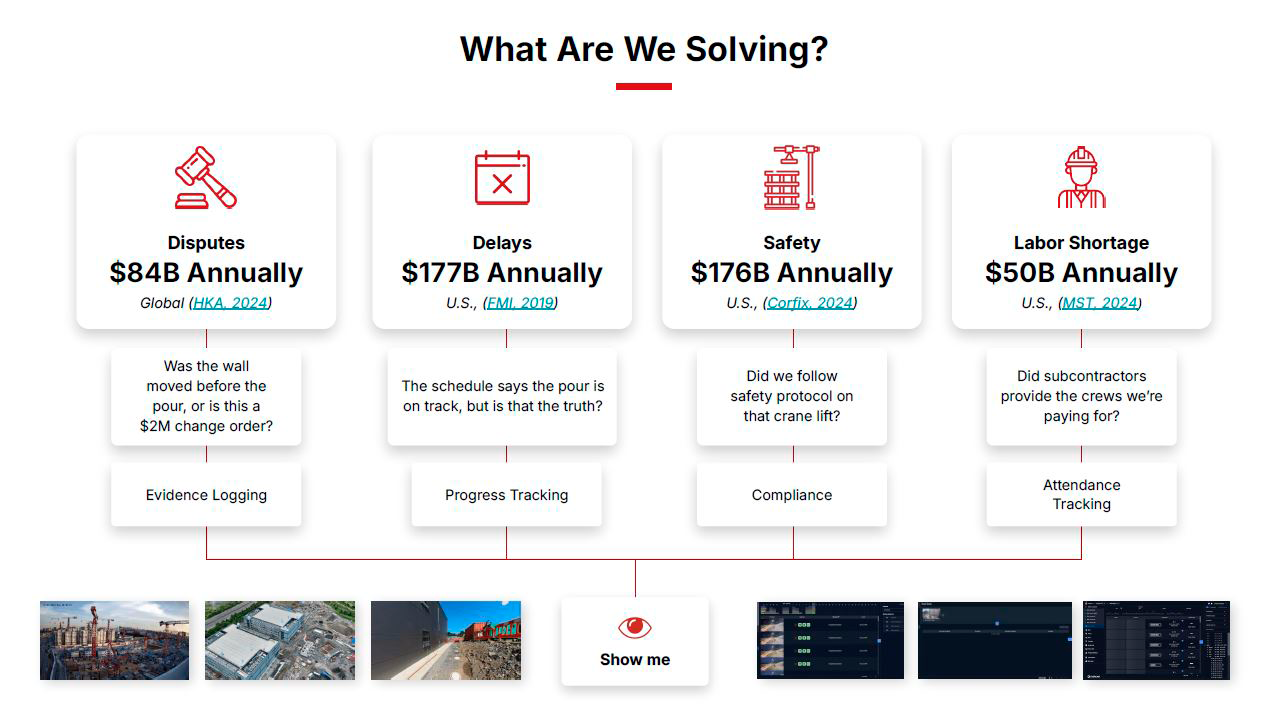
Reality capture means you can.
With Evercam, "Show me" becomes a timestamped replay. Not a dispute.
When that happens, we don't need to be the system of record. Because everyone else will start deferring to our truth. The schedule doesn't go away. But it finally starts working the way it should.
We don't replace the record. We make it reliable.
Because if the truth is already captured, and can be structured, surfaced, and shared, the need to report everything manually disappears. Procore becomes a UI layer for formal documentation. P6 becomes a readout of plan vs actual. But the source of truth, what actually happened, starts and ends with reality capture.
That's our role. Not to replace the systems of record directly, but to become the layer they rely on. Quietly. Invisibly. Irrefutably.
What Happens When the Schedule Writes Itself?
Let's say we stop asking whether the project is on schedule and just know.
Let's say we stop relying on a field engineer to update a spreadsheet and instead pull up a timeline view of what actually happened, backed by footage and linked to milestones.
Now forecasting gets better. Now claims are grounded in truth. Now we know which subcontractors are ahead or behind based on real data, not anecdotes.
And now we can feed all of that backward into estimating, so the next project's plan is based on what actually happens, not what we wish would happen.
Winning Through Partnership & Bundling
The systems of record — Autodesk, Oracle, Procore - aren’t going anywhere. They’ve built too much gravity. Too many contracts, too many integrations, too much inertia. The logical next move for them is simple: build or buy their own reality capture capabilities. It’s predictable. It’s smart. And it’s already starting.
But the real competition for Procore won’t come from another documentation platform. It’ll come from a reality capture company that moves upstream. One that stops being a tool used by the system of record — and starts being the infrastructure beneath it.
Right now, there’s a wave forming underneath them. The Evercams, Buildots, Voyage Controls, Foresights, Kahuas, Linarcs, Visleans — all the point solutions building real visibility into what’s actually happening on site. Individually, none of them can take down a Procore. But together? Through bundling, partnerships, shared primitives, and tighter integrations — they can start to shift the center of gravity.
That’s how ecosystems evolve. Not overnight, but through consolidation. Through workflows that become habits. Through data that becomes indispensable.
Some of these companies will bundle and rise upstream. Some will get acquired by the big three. A few will build something entirely new — a single pane of glass where the plan, the record, and reality finally live together.
Just like in healthcare, the system of record will stay the system of record — but it’ll start relying on a new layer of truth underneath it. The truth captured, structured, and surfaced by reality capture.
Because when you own the capture layer, you understand how the client wants to use the data. That’s where leverage comes from. That’s where value compounds.
Reality capture complements humans today. In ten years, humans will complement automated insights from visual data.
We'll still have people in the loop, but increasingly, they'll be interacting with systems of truth, not maintaining them.